How to Play Hitori: Rules, Strategy, and Tips for Beginners
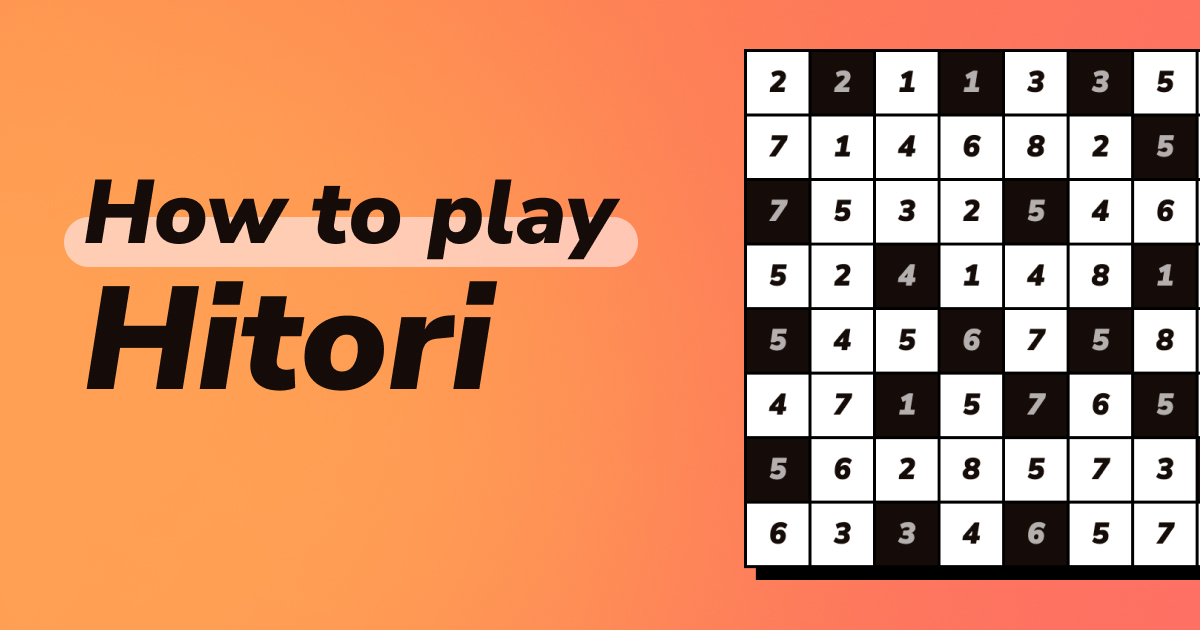
Hitori is a Japanese logic puzzle invented by Nikoli in 1990. You're given a square grid filled with numbers, and your job is to shade cells black so the same number never appears twice in the same row or column. The catch: no two adjacent black cells are allowed, and every unshaded cell must stay connected to the others.
It's a cousin of Sudoku and Kakuro, made by the same publisher, but the mechanic is inverted: instead of filling empty cells in, you shade filled cells out. The name hitori (一人) means "alone" or "leave me alone" in Japanese — a nod to the rule that every number in the final grid must stand alone in its row and column.
This guide covers the full rules, the two patterns every beginner should learn first, and the common deductions that show up in nearly every puzzle. If you'd rather just start playing, jump into a free Hitori puzzle in 5×5, 8×8, or 12×12.
The Rules of Hitori
Hitori is played on a grid of squares, usually 5x5 or 6x6. Each square contains a number, which represents its value. The goal of the game is to shade in some of the squares so that no number appears more than once in any row or column. Additionally, no shaded square can be adjacent to another shaded square, either horizontally or vertically. The unshaded squares must form a continuous path through the grid, either horizontally or vertically.
Here's an example of a Hitori puzzle:
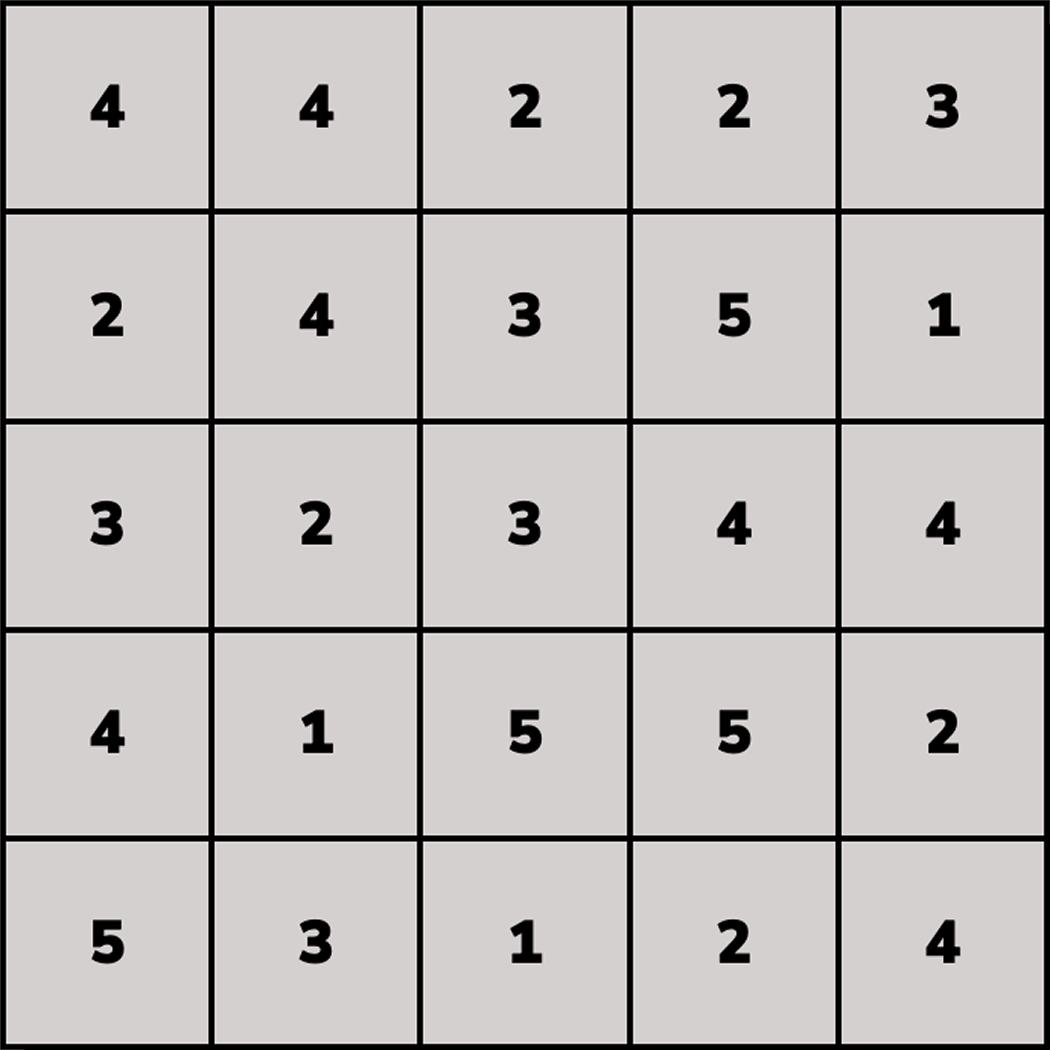
In this puzzle, the goal is to shade in some of the squares so that no number appears more than once in any row or column. Additionally, no shaded square can be adjacent to another shaded square, either horizontally or vertically. The unshaded squares must form a continuous path through the grid, either horizontally or vertically.
Tips & Tricks
- Start with the largest numbers: In Hitori, it's often helpful to start with the largest numbers first. These numbers are the most restrictive, since they can't appear again in any row or column. Look for places where a large number is the only number in a row or column, and shade in all the other squares. This can help you eliminate possibilities and make the puzzle easier to solve.
- Look for patterns: Hitori puzzles often have patterns that can help you solve them. For example, if you see a sequence of three numbers in a row or column, and the first and third numbers are the same, you can shade in the middle number. This is because the middle number can't be the same as the first or third number, so it must be shaded.
- Use logic: Hitori is a logic puzzle, so use your logical reasoning skills to solve it. If you know that a certain number can't appear in a certain row or column, use that information to eliminate possibilities in other squares. Look for places where a shaded square would create a contradiction, and use that to eliminate possibilities as well.
- Practice, practice, practice: Like any game, the more you play Hitori, the better you'll get at it. Don't get discouraged if you can't solve a puzzle right away. Keep practicing, and eventually you'll develop the skills you need to solve even the most difficult puzzles.
Frequently Asked Questions
What are the rules of Hitori?
Hitori has three rules. First, the same number cannot appear more than once in the same row or column. Second, no two adjacent black cells are allowed — shaded cells can't touch horizontally or vertically. Third, all unshaded (white) cells must stay connected in a single group. You solve the puzzle by shading the right cells to satisfy all three rules at once.
What is the strategy behind Hitori?
Hitori strategy centers on pattern recognition, and two patterns solve most early cells. The sandwich (three cells in a line reading X Y X): the middle cell must stay white, because either flanking X may need to be shaded and no two adjacent black cells are allowed. The pair (two cells with the same number side by side): one of the two must stay white, which means every other copy of that number in the same row or column must be shaded. Chaining these deductions cracks most puzzles.
Is Hitori similar to Sudoku?
Hitori and Sudoku are cousins — both are Japanese logic puzzles from Nikoli, both involve numbers in a grid, and both reward pure logic with no guessing or arithmetic. The mechanic is inverted, though: in Sudoku you fill empty cells with numbers, while in Hitori you start with every cell filled and shade duplicates out. Sudoku fans often pick up Hitori next because the deduction style feels familiar but fresh.
What does "Hitori" mean?
Hitori (一人) is Japanese for "alone" or "one person," often translated as "leave me alone." The name refers to the core rule: no number can appear more than once in any row or column, so every surviving digit stands alone in its line.
Is Hitori a Japanese puzzle?
Yes. Hitori was invented by the Japanese puzzle publisher Nikoliand first appeared in March 1990 in issue 29 of Nikoli's Puzzle Communication magazine. It sits in the same family as Sudoku, Kakuro, Nurikabe, and Slitherlink — all puzzles popularized by Nikoli and its founder, Maki Kaji.
What size Hitori puzzle should a beginner start with?
Start with a 5×5 grid. It teaches the three rules and the sandwich/pair patterns in a few minutes. Once those feel automatic, move up to 8×8, and save 12×12 for when chained deductions feel natural.
Is Hitori harder than Sudoku?
For most players, Hitori at the same grid size is slightly easier than Sudoku because shading has a smaller search space than filling. At 12×12, though, Hitori becomes genuinely demanding — chain deductions can stretch across the whole grid, and the "all white cells must stay connected" rule creates global constraints that smaller grids don't expose.
Play Hitori now!
Hitori is a fun and challenging game that requires logical reasoning and pattern recognition skills. By following these tips and tricks, you can become a Hitori master and impress your friends with your puzzle-solving abilities. So grab a pencil and a piece of paper, and start playing Hitori today!
And if you're looking for more brain-stimulating games to play, read our list of daily word and logic games, or try our Midi Crossword puzzle now. Or if you enjoy number logic, learn how to play Kakuro — it combines the crossword grid structure with arithmetic challenges.
 Mini Crossword
 Midi Crossword
 Diffle
 Killer Sudoku
 Numberle